Ceres
Dwarf planet
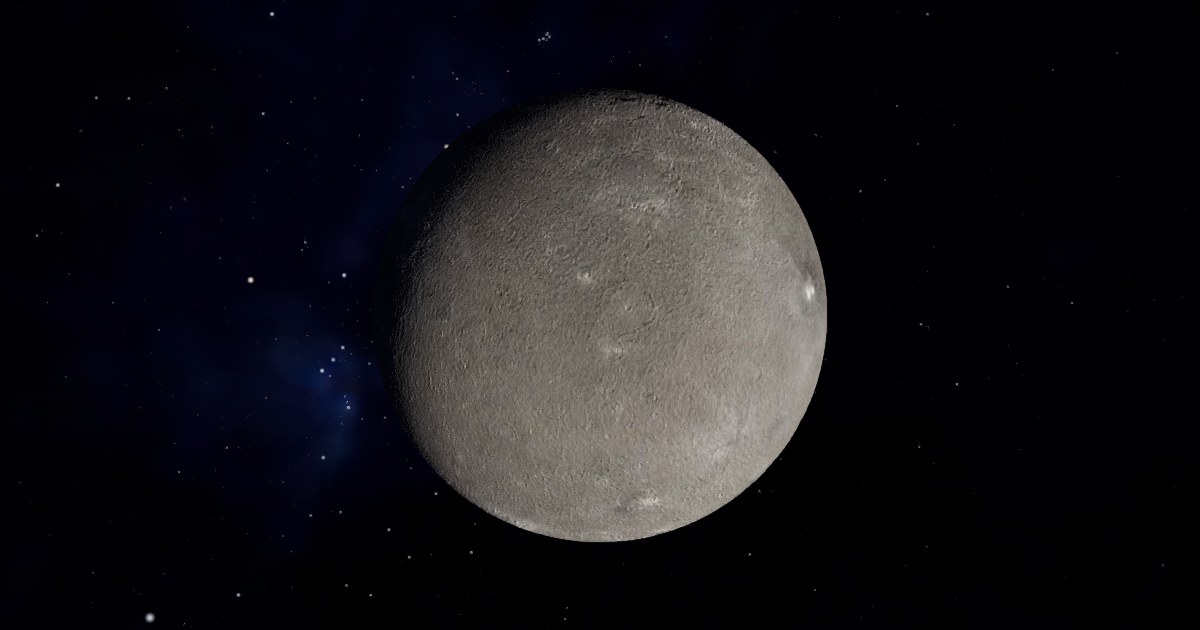
Ceres is the biggest object in the asteroid belt between Mars and Jupiter. It alone grew big enough for its own gravity to pull it into a ball. That's why Ceres is a dwarf planet.
Free, with nothing to install: drag to rotate the view, scroll or pinch to zoom, and change the date with the time bar.
More in the model: Look inside
Key data
| Diameter | 964 km (599 mi) | 0.076× Earth |
|---|---|---|
| Mass | 9.4 × 10²⁰ kg (2.1 × 10²¹ lb) | tiny compared with Earth |
| Gravity | 0.029 g | 3% of Earth's |
| One day | 9.1 hours | one full turn on its axis |
| One year | 4.6 years | 1,680 Earth days |
| Temperature | −163 to −38 °C (−261 to −36 °F) | coldest to hottest spot |
| Moons | 0 | no moons |
| Axial tilt | 4° | nearly upright |
Facts
Fun fact
For a long time, no one could explain the bright white spots on Ceres. They're salt left behind by salty water that once welled up from underground.
For the curious
Ceres is about 960 km (600 miles) across, a little farther than a straight-line trip from Chicago to Atlanta. It accounts for nearly two-fifths of the mass of the entire asteroid belt. On January 1, 1801, Giuseppe Piazzi discovered Ceres, the first asteroid ever found. It orbits the Sun every 4.6 years.