International Space Station (ISS)
Space station · NASA, Roscosmos, ESA, JAXA, CSA
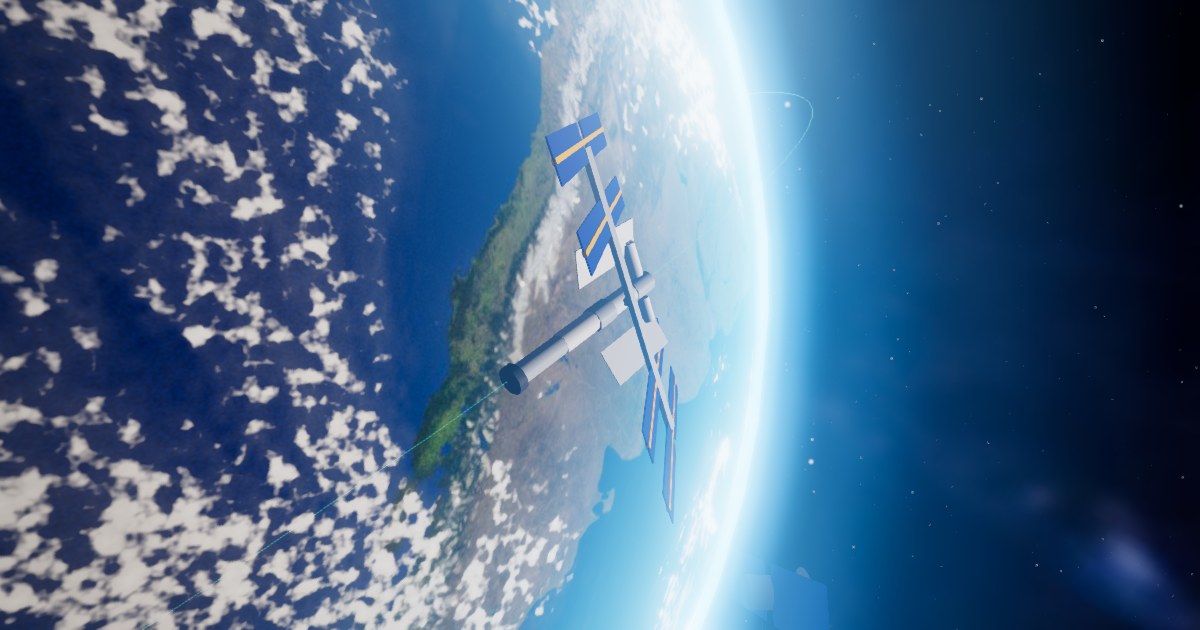
The International Space Station (ISS) is the biggest thing people have built in space. It circles Earth about 420 km (260 miles) up. Usually, seven people from different countries live there. They float around weightless and do experiments they couldn’t do on Earth.
Free, with nothing to install: drag to rotate the view, scroll or pinch to zoom, and change the date with the time bar.
Key data
| Launch | November 20, 1998 | Zarya module |
|---|---|---|
| Length | 109 m (357.6 ft) | as long as a football field |
| Mass | 420 t (925,942 lb) | 419,725 kg to be exact |
| Crew | 7 people | crewed since November 2, 2000 |
Facts
Fun fact
The station circles Earth in about 93 minutes. That gives the crew 16 sunrises and 16 sunsets in a single day. You can see the station without a telescope. Look for a bright “star” that doesn't twinkle and crosses the sky in a few minutes. NASA calls it the third-brightest object in the sky, after the Sun and the Moon. Find out when it will fly over you at spotthestation.nasa.gov.
For the curious
The station travels at about 27,600 km/h (17,200 mph), or 7.7 km/s. At that speed, a trip from Orlando to Jacksonville would take about 25 seconds. Even at an altitude of 420 km (260 miles), traces of air gradually slow the station down. Its engines raise its orbit every few weeks. NASA plans to keep the station in orbit through 2030. After that, controllers will guide it back into the atmosphere over a remote part of the ocean, where most of it will burn up.
Orbits
Key moments
- Zarya
- On November 20, 1998, a Proton rocket lifted off from Baikonur carrying the first module, Russia’s Zarya. Construction of the station had begun.
- First crew
- The first long-term crew arrived on November 2, 2000. Someone has lived on the station ever since.
- Fully assembled
- Atlantis lifted off on the final space shuttle flight on July 8, 2011, marking the end of construction on the original station. More modules came later, most recently Prichal in November 2021.
- Planned end
- NASA plans to keep the station in orbit through 2030. After that, controllers will guide it back into the atmosphere over a remote part of the ocean. The plan could change.