Ganymede
Moon · orbits Jupiter
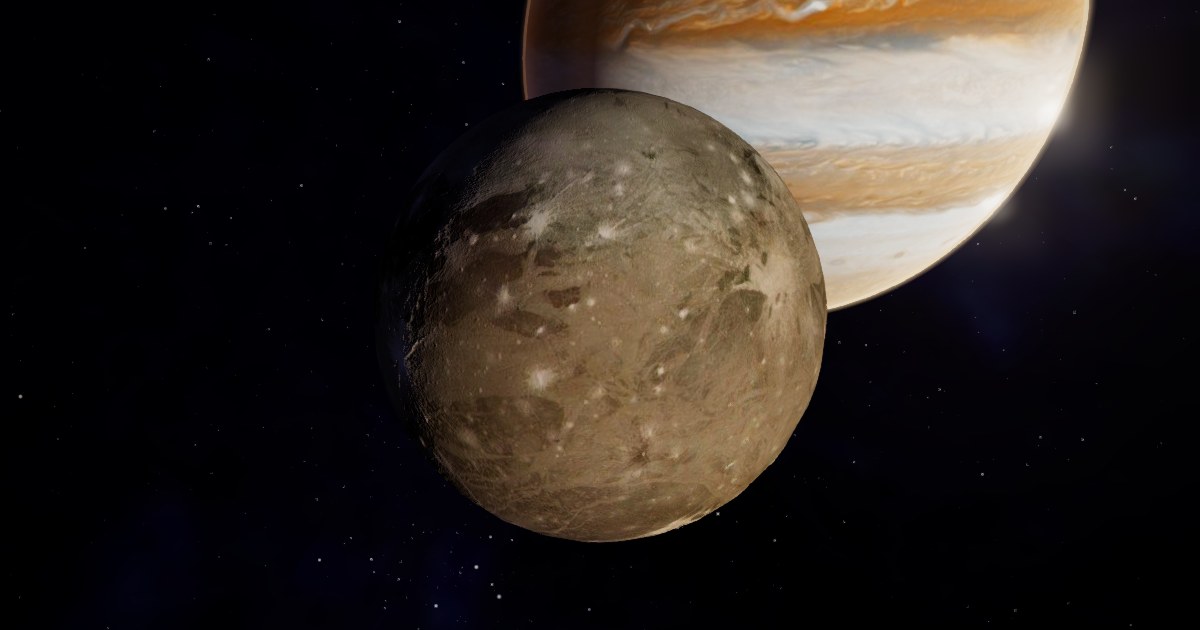
Ganymede is the biggest moon in the Solar System. It's even bigger than the planet Mercury. Its surface is made of ice and rock.
Free, with nothing to install: drag to rotate the view, scroll or pinch to zoom, and change the date with the time bar.
More in the model: Look inside
Key data
| Diameter | 5,268 km (3,273 mi) | 0.41× Earth |
|---|---|---|
| Mass | 0.025× Earth | |
| Gravity | 0.15 g | 15% of Earth's |
| Rotation | 7.2 days | same side always faces the planet |
| One orbit | 7.2 days | around Jupiter |
| Temperature | −160 °C (−256 °F) | surface average |
| Axial tilt | 0° | upright |
Facts
Fun fact
Ganymede is the only moon with a magnetic field of its own. Thanks to that field, it even has auroras, lights that glow near its poles.
For the curious
Ganymede is wider than Mercury, with a diameter of 5,268 km (3,273 miles) compared with Mercury's 4,879 km (3,032 miles). Because so much of Ganymede is ice, it has only half Mercury's mass. It orbits Jupiter every 7.15 days.