Parker Solar Probe
Solar probe · NASA
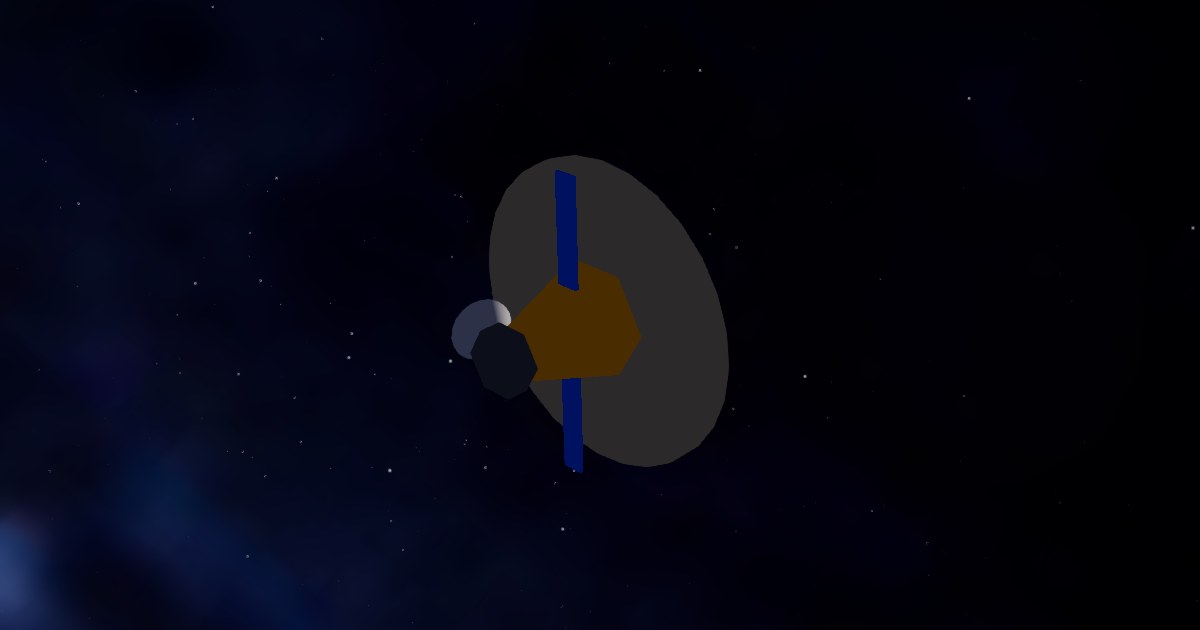
Parker Solar Probe flies closer to the Sun than any other spacecraft. It was the first to fly into the corona, the Sun’s hot outer layer. A shield protects it from the heat. Its instruments stay in the shade behind the shield.
Free, with nothing to install: drag to rotate the view, scroll or pinch to zoom, and change the date with the time bar.
Key data
| Launch | August 12, 2018 | NASA |
|---|---|---|
| Heat shield | 2.3 m (7.5 ft) | carbon foam, 11.5 cm thick |
| Nearest the Sun | 6.1 million km (3.79 million mi) | Dec. 24, 2024, above the surface |
Facts
Fun fact
Parker is the fastest machine people have ever built. Near the Sun, it flies at about 690,000 km/h (430,000 mph). At that speed, it could get from Orlando to Jacksonville in about a second. Its heat shield can handle about 1,400 °C (2,550 °F). In the shade behind it, it’s only about 30 °C (86 °F).
For the curious
Parker follows an elongated orbit around the Sun, swinging in close about every three months. Its heat shield is made of carbon foam sandwiched between two carbon panels. It first reached its record distance on December 24, 2024, about 6.1 million km (3.8 million miles) above the Sun’s surface, or 9.9 solar radii from its center. Seven earlier Venus flybys used the planet’s gravity to bring Parker’s orbit closer to the Sun. The model has orbital data through 2030 and stops showing the spacecraft beyond that point.
Key moments
- Launch
- Parker Solar Probe lifted off from Florida on a Delta IV Heavy rocket on August 12, 2018.
- 1st Venus flyby
- Parker made its first of seven Venus flybys on October 3, 2018.
- Corona dive
- Parker first flew into the Sun’s outer atmosphere, the corona, on April 28, 2021.
- Last Venus flyby
- Parker made its seventh and final Venus flyby on November 6, 2024.
- Nearest the Sun
- On December 24, 2024, Parker flew about 6.1 million km (3.8 million miles) above the Sun’s surface at about 690,000 km/h (430,000 mph).