Pioneer 10
Pioneering probe · NASA
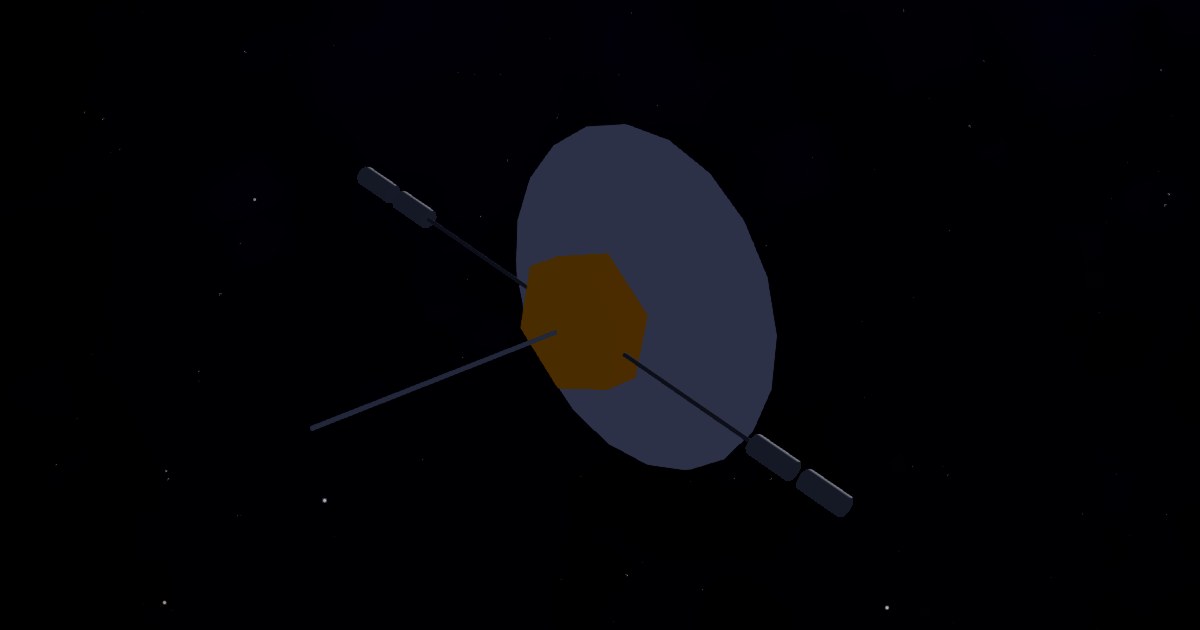
Pioneer 10 was the first spacecraft to cross the asteroid belt and the first to reach Jupiter. It showed that a spacecraft could fly safely through the belt. That opened the way for every later trip to the outer planets.
Free, with nothing to install: drag to rotate the view, scroll or pinch to zoom, and change the date with the time bar.
Key data
| Launch | March 3, 1972 | NASA |
|---|---|---|
| Last signal | Jan. 23, 2003 | about 82 au from the Sun |
| Plaque | 23 × 15 cm (9.1 in × 5.9 in) | gold-plated aluminum |
Facts
Fun fact
Pioneer 10 carries a gold-plated plaque with a drawing of a man and a woman. A map shows where to find the Sun, and a picture shows the Solar System the spacecraft is leaving. It’s a greeting for anyone who might find it someday. Its last faint signal reached Earth on January 23, 2003.
For the curious
Pioneer 10 reached Jupiter in December 1973 and measured stronger radiation there than anyone expected. It has been silent since 2003. Its trajectory can still be calculated from gravity, so the model continues to show it. Beyond 2050, its position is only an estimate. It’s heading toward the star Aldebaran and would reach it in about two million years. It’s traveling in the opposite direction from the Voyagers, into the tail of the bubble around the Sun. The tail extends much farther than the nose. Pioneer 10 probably hasn’t crossed the heliopause yet, though this is an estimate because little is known about the tail.
Key moments
- Launch
- Pioneer 10 lifted off from Florida on an Atlas rocket on March 2, 1972. It was already March 3 in UTC.
- Jupiter
- Pioneer 10 came closest to Jupiter on December 4, 1973 (UTC), about 130,000 km (81,000 miles) above the clouds. It was still the evening of December 3 in the United States.
- Last signal
- The last faint signal reached Earth on January 23, 2003. Pioneer 10 travels on alone.