BepiColombo
Mercury probe · ESA and JAXA
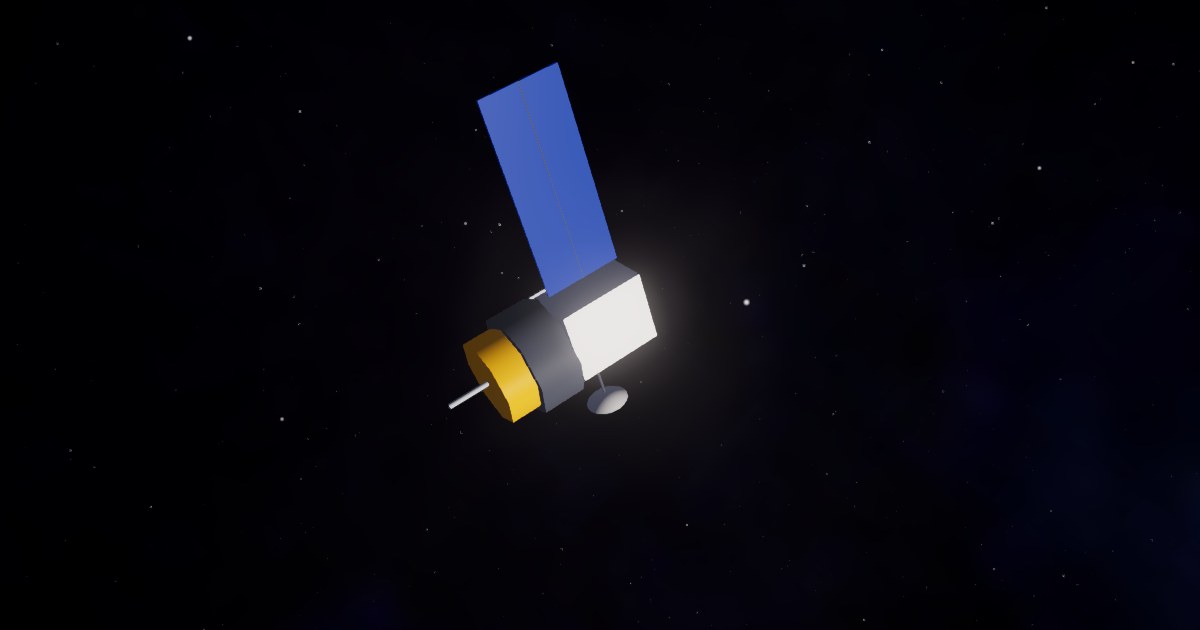
Europe and Japan teamed up to send BepiColombo to Mercury, the smallest planet in the Solar System. Two spacecraft made the trip together. Europe’s MPO maps Mercury and takes measurements. Japan’s Mio studies the space around Mercury and its magnetic field, the region where magnetic forces act. For the first time, two spacecraft will work at Mercury at the same time.
Free, with nothing to install: drag to rotate the view, scroll or pinch to zoom, and change the date with the time bar.
Key data
| Launch | October 20, 2018 | ESA and JAXA |
|---|---|---|
| Trip | 8 years | from launch on October 20, 2018 to capture on November 21, 2026 |
| Planetary flybys | 9 | Earth, Venus ×2, Mercury ×6 |
| Launch mass | 4.1 t (9,039 lb) | four parts: MTM, MPO, Mio, and the MOSIF shield |
Facts
Fun fact
The mission is named for Giuseppe “Bepi” Colombo, an Italian mathematician and engineer. He figured out how to use Venus’s gravity to send Mariner 10 to Mercury. Reaching Mercury is harder than reaching Pluto. As a spacecraft falls toward the Sun, it picks up speed. It has to slow way down or it will fly right past the little planet. That’s why the trip took eight years. BepiColombo got help from a planet’s gravity nine times along the way. It swung past Earth once, Venus twice, and Mercury six times.
For the curious
BepiColombo traveled in a stack of four parts. At the base was the Mercury Transfer Module (MTM), with its ion engines and large solar panels. Europe’s Mercury Planetary Orbiter (MPO) sat above it, with Japan’s Mio on top, protected by the MOSIF shield. The MTM separated on September 3, 2026. With Mio still aboard, MPO used its own engines to slow down. Starting at 6:24 PM UTC (1:24 PM Eastern time) on November 21, 2026, four engines fired for 37 minutes, allowing Mercury’s gravity to capture the spacecraft. Mio is due to separate from MPO on December 9–10, 2026. MPO will follow a polar orbit ranging from 480 to 1,500 km (300 to 930 miles) above Mercury, with an orbital period of 2.3 hours. Mio’s orbit will range from 590 to 11,640 km (370 to 7,230 miles), with a period of 9.3 hours. Science observations are scheduled to begin in April 2027. The model shows BepiColombo until Mio separates. After that, the two spacecraft follow separate orbits around Mercury.
Key moments
- Launch
- BepiColombo lifted off from Kourou, French Guiana, on an Ariane 5 rocket at 1:45 AM UTC on October 20, 2018.
- Earth
- BepiColombo flew past Earth on April 10, 2020, about 12,700 km (7,890 miles) above the surface. Earth’s gravity bent its path toward Venus.
- Venus 1
- On October 15, 2020, BepiColombo flew past Venus for the first time, about 10,700 km (6,650 miles) above the surface.
- Venus 2
- On August 10, 2021, BepiColombo flew past Venus for the second time, just 550 km (340 miles) above the surface. The flyby set it on course for Mercury.
- Mercury 1
- On October 1, 2021, BepiColombo made the first of six Mercury flybys, about 200 km (120 miles) above the surface. The spacecraft took its first pictures of the planet.
- Mercury 6
- On January 8, 2025, the spacecraft made its sixth and final Mercury flyby. It passed about 300 km (190 miles) above the surface. From there, it followed its own path toward Mercury.
- MTM separates
- On September 3, 2026, the Mercury Transfer Module (MTM) separated, taking its ion engines with it. MPO and Mio continued toward Mercury on their own.
- Capture
- Starting at 6:24 PM UTC on November 21, 2026, MPO fired four engines for 37 minutes. That slowed the spacecraft enough for Mercury’s gravity to capture it. It’s the first spacecraft to orbit Mercury since the MESSENGER mission ended in 2015.
- Mio separates
- MPO and Mio will separate on December 9–10, 2026. The model stops showing BepiColombo here. From then on, each spacecraft follows its own orbit.