Saturn
Gas giant · #6 from the Sun
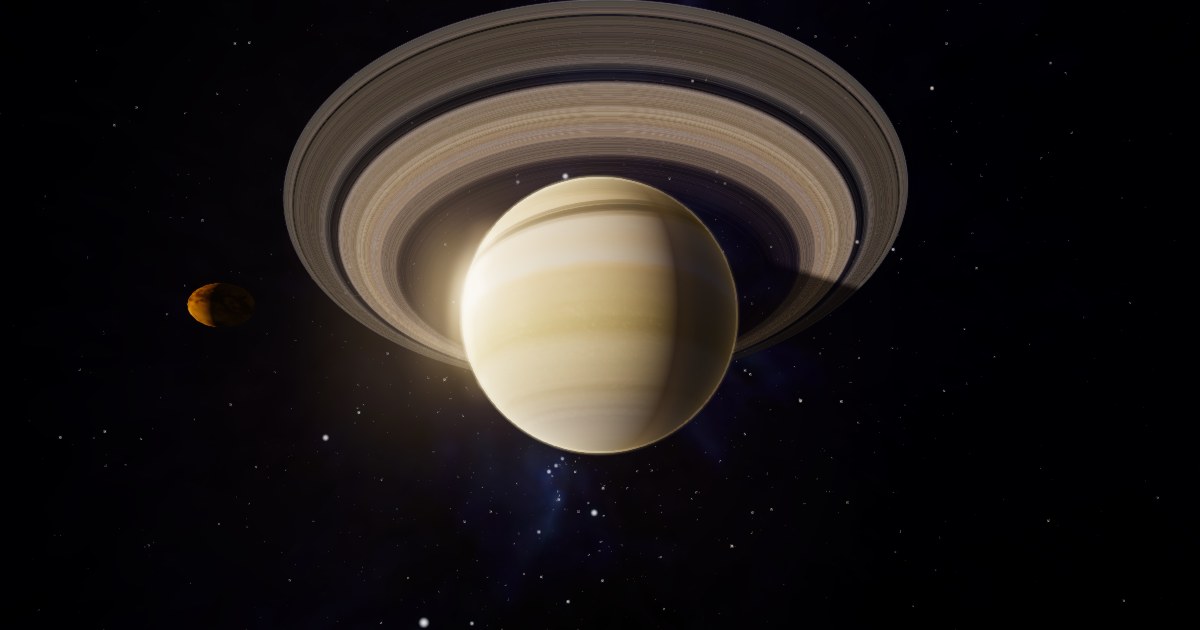
You can spot Saturn by its rings. They look like solid hoops, but each holds countless bits of ice and rock. Some are tiny grains. Others are boulders as big as houses. Saturn itself is a giant ball of gas like Jupiter.
Free, with nothing to install: drag to rotate the view, scroll or pinch to zoom, and change the date with the time bar.
More in the model: Look inside
Key data
| Diameter | 120,536 km (74,898 mi) | 9.4× Earth |
|---|---|---|
| Mass | 95.2× Earth | |
| Gravity | 1.1 g | 107% of Earth's |
| One day | 10.7 hours | one full turn on its axis |
| One year | 29.5 years | 10,759 Earth days |
| Temperature | −140 °C (−220 °F) | in the clouds (1 bar) |
| Moons | 292 | and more are being found |
| Axial tilt | 26.7° | slightly tilted |
Facts
Fun fact
Saturn is the only planet with an average density lower than water's. If you could find a bathtub big enough, Saturn would float.
For the curious
Saturn's rings span about 280,000 km (170,000 miles) from edge to edge, yet most are only about 10 meters (30 feet) thick. As of April 2026, Saturn has more than 290 known moons, the most of any planet.