Sputnik 1
First man-made satellite · USSR
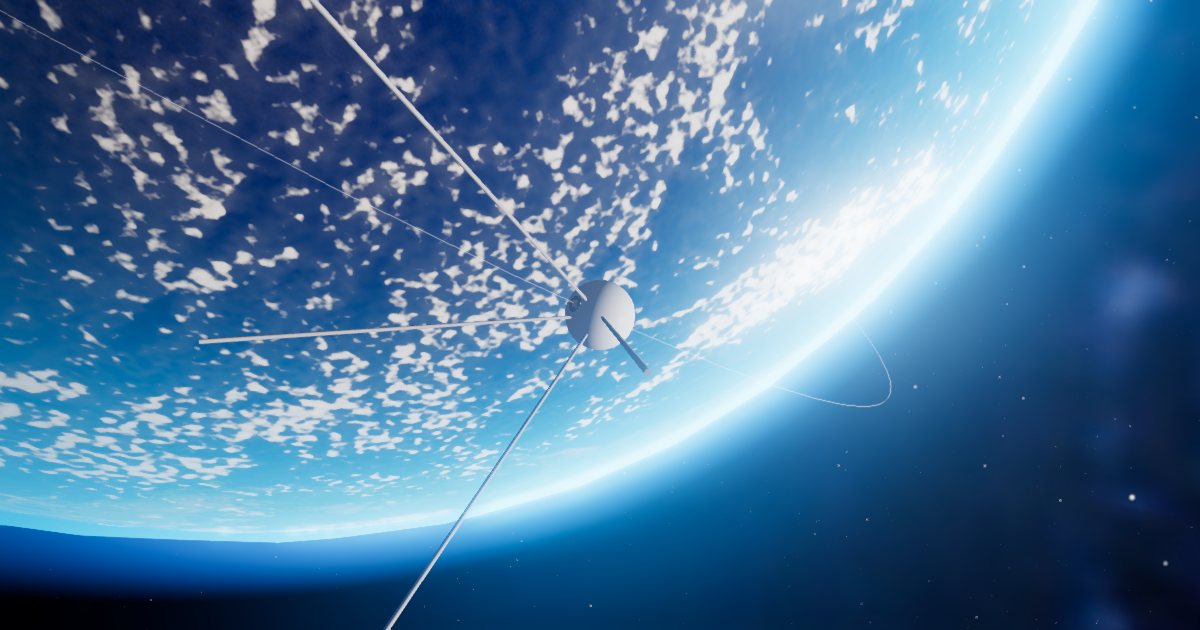
Sputnik 1 was the first satellite people ever sent into orbit around Earth. The Soviet Union launched it on October 4, 1957. That day, the Space Age began. It was a shiny metal ball the size of a beach ball, with four long antennas. You could hear it go “beep, beep, beep” on the radio.
Free, with nothing to install: drag to rotate the view, scroll or pinch to zoom, and change the date with the time bar.
Key data
| Launch | October 4, 1957 | R-7 rocket |
|---|---|---|
| Diameter | 58 cm (1.9 ft) | like a beach ball |
| Mass | 83.6 kg (184.3 lb) | about as heavy as an adult |
| In orbit | 92 days | October 4, 1957 to January 4, 1958 |
Facts
Fun fact
Sputnik 1 sent out beeps on two radio frequencies, 20.005 and 40.002 MHz. Ham radio operators around the world could hear them on shortwave radios. The batteries lasted about three weeks, until October 26, 1957. Then the satellite went quiet, but it kept circling Earth for over two more months. In Russian, “sputnik” means a traveling companion, someone who goes on a journey with you.
For the curious
Sputnik 1 followed an elongated orbit, ranging from about 215 to 939 km (134 to 583 miles) above Earth. Each orbit took 96 minutes. Atmospheric drag slowed the satellite and gradually lowered its orbit. On January 4, 1958, after about 92 days and 1,440 orbits, Sputnik 1 burned up in the atmosphere. The model uses a fixed orbit throughout. Its position along that orbit is always an estimate because we lack precise records of its location at any given time.
Orbits
Key moments
- Launch
- An R-7 rocket lifted off from Baikonur at 7:28 PM UTC on October 4, 1957. It was already October 5 at the launch site. The Space Age had begun.
- Last beep
- Around October 26, 1957, the batteries ran out and the radio fell silent. The satellite kept circling Earth.
- Reentry
- On January 4, 1958, about 92 days after launch, the satellite entered the atmosphere and burned up.