Voyager 1
Outer Solar System probe · NASA
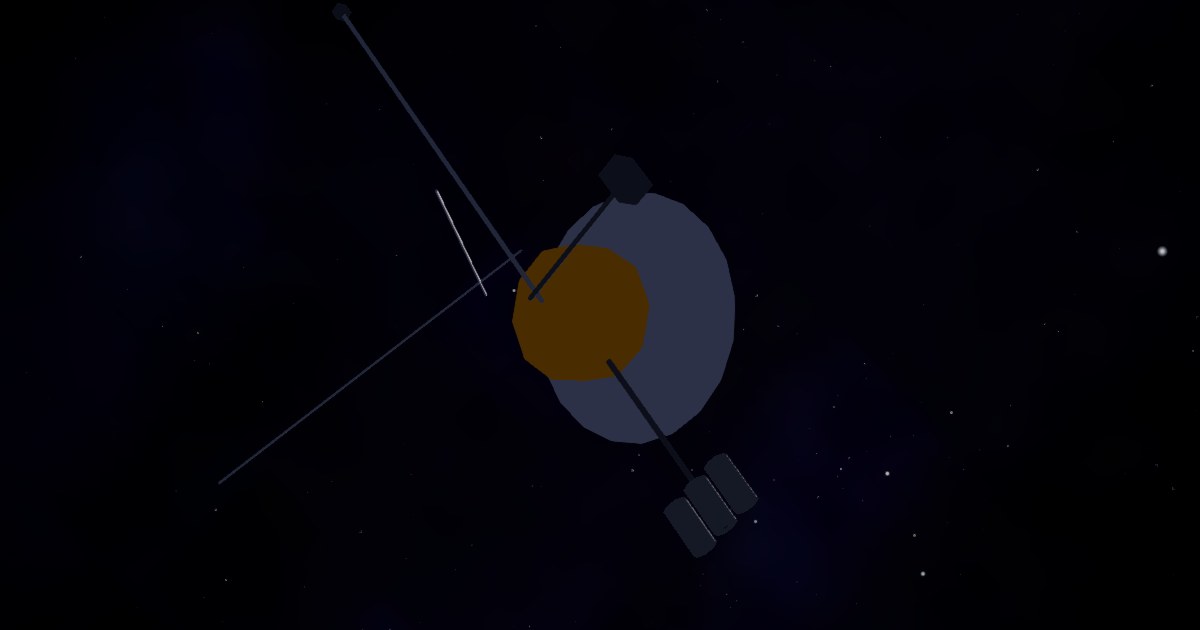
Voyager 1 is farther from Earth than anything else people have made. It’s been flying since 1977 and saw Jupiter and Saturn up close along the way. It was the first spacecraft to leave the huge bubble the Sun blows around itself. Now it’s flying through the space between stars.
Free, with nothing to install: drag to rotate the view, scroll or pinch to zoom, and change the date with the time bar.
Key data
| Launch | September 5, 1977 | NASA |
|---|---|---|
| Large antenna | 3.7 m (12.1 ft) | always points at Earth |
| Plutonium batteries | 3 RTGs | power drops each year |
Facts
Fun fact
Voyager 1 carries the Golden Record, a gold-plated record 30 cm (12 inches) across. It holds greetings in 55 languages, sounds from Earth, music, and 115 pictures. If anyone out there ever finds it, they can learn where it came from. In November 2026, Voyager 1 reached a milestone. For the first time, it was more than one light-day from Earth, about 26 billion km (16 billion miles). A radio signal from Earth takes more than 24 hours to reach it.
For the curious
Voyager 1 flew past Jupiter in 1979 and Saturn and its moon Titan in 1980. In February 1990, it looked back and photographed Earth as a “pale blue dot.” On August 25, 2012, about 120 au from the Sun, it crossed the heliopause, the boundary where the solar wind gives way to interstellar gas. Three plutonium-powered radioisotope thermoelectric generators supply its electricity. Their output is falling, and sometime in the 2030s they’ll probably be unable to power even one instrument. The spacecraft will keep traveling after it falls silent.
Key moments
- Launch
- Voyager 1 lifted off from Florida on a Titan rocket on September 5, 1977.
- Jupiter
- Voyager 1 came closest to Jupiter on March 5, 1979, about 280,000 km (170,000 miles) above the clouds. It discovered volcanoes on Jupiter’s moon Io.
- Saturn
- Voyager 1 came closest to Saturn on November 12, 1980, about 126,000 km (78,300 miles) above the clouds. It also flew past Titan, then headed above the plane of the planets.
- Pale Blue Dot
- On February 14, 1990, Voyager 1 photographed Earth from about 40 au away. Our planet looked like a tiny pale blue dot.
- Heliopause
- On August 25, 2012, Voyager 1 became the first spacecraft to leave the bubble of solar wind around the Sun. It was about 122 au from the Sun.