Voyager 2
Outer Solar System probe · NASA
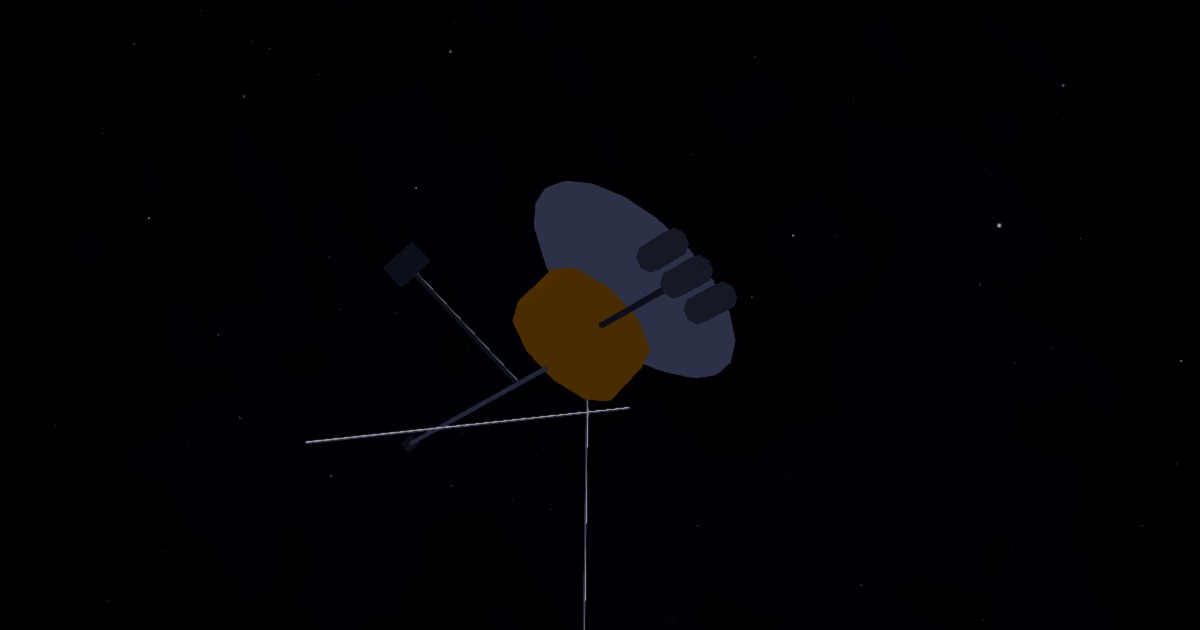
Voyager 2 is the only spacecraft to visit all four giant planets. They’re Jupiter, Saturn, Uranus, and Neptune. The planets lined up just right for the trip. That happens only about once every 175 years. No other spacecraft has seen Uranus or Neptune up close.
Free, with nothing to install: drag to rotate the view, scroll or pinch to zoom, and change the date with the time bar.
Key data
| Launch | August 20, 1977 | NASA |
|---|---|---|
| Large antenna | 3.7 m (12.1 ft) | always points at Earth |
| Planets visited | 4 | Jupiter, Saturn, Uranus, Neptune |
Facts
Fun fact
At Uranus, Voyager 2 discovered 10 moons and two rings. At Neptune, it found the Great Dark Spot and geysers on the moon Triton. It launched 16 days before Voyager 1, but it’s slower, so it’s still closer to Earth. It carries a Golden Record, too.
For the curious
Voyager 2 entered interstellar space on November 5, 2018, about 119 au from the Sun. Since its Neptune flyby, it has headed far below the plane of the planets, toward the southern sky. Only the large antenna near Canberra, Australia, can send it commands.
Key moments
- Launch
- Voyager 2 lifted off from Florida on a Titan rocket on August 20, 1977.
- Jupiter
- Voyager 2 came closest to Jupiter on July 9, 1979, about 645,000 km (401,000 miles) above the clouds.
- Saturn
- Voyager 2 came closest to Saturn on August 26, 1981, about 101,000 km (62,800 miles) above the clouds.
- Uranus
- Voyager 2 came closest to Uranus on January 24, 1986, about 81,500 km (50,600 miles) above the clouds. It’s the only spacecraft ever to visit Uranus.
- Neptune
- Voyager 2 came closest to Neptune on August 25, 1989, about 4,800 km (3,000 miles) above its north pole. It’s the only spacecraft ever to visit Neptune.
- Heliopause
- On November 5, 2018, Voyager 2 left the bubble of solar wind around the Sun. It was about 119 au from the Sun.